
One of several films at San Sebastian this year centered around the world of art, In My Father’s Room brings a welcome thread of realism to its arty subject while it gently pulls the viewer into an esthete Japanese culture. The patient viewer who gets through the film’s somewhat slow-moving introductory scenes will find much to appreciate in the story of Satomi, a museum guard who is let go after faithfully watching over a Mark Rothko painting of inestimable value for twenty years. As tastefully reserved as it is visually striking, the film is earmarked for the art house crowd. It bowed in competition at San Sebastian.
This is the first film directed by best-selling Japanese novelist Maha Harada, based on her short story “An Unnecessary Man”. Her art-inspired novels like Canvas of Paradise and Guernica Cover-Up and her personal experience in museum curation lend an air of authenticity to the setting and the main character, who sees her job as a great blessing rather than the monotonous drudgery it looks like from the outside.
Played with self-effacing modesty by the well-known TV actress Yu Aoi, Satomi is a shy young woman without friends, suitors or professional prospects. She hides her attractiveness in oversize clothes and uniforms, a source of criticism from her flamboyantly dressed mother, who is into renting designer clothes for any occasion. Their lunch to celebrate Satomi’s 40th birthday is a delightful riff on mother-daughter contrasts. Yet we feel an easy current of love running between the two, despite their dissimilarities.
Satomi’s parents divorced after 50 years of marriage and her father, after living a few years on his own, has recently died. Not coincidentally, she receives a package in the mail containing a single key and an address. Its narrative function is to trigger her to find out more about her Dad, a loner poet whose extremely delicate aesthetic sensibility she has inherited.
The film shifts gears when he appears on the scene as an absent-minded, white-haired man (Issey Ogata) who has no more social ties, but dedicates himself to the beauty of words. His secret life is revealed to Satomi by a young antique dealer (Eita Nagayama) who became his friend at the end of his life. A 400-year-old bowl, his prize objet d’art, inspired the elderly man to enact an imaginary tea ceremony that is quite impressive to watch. And when Satomi discovers a rare volume of her father’s collected poems, we listen to him read several of them offscreen. (These exquisite, moving poems reference 20th century haiku poet Yamaguchi Seishi.)
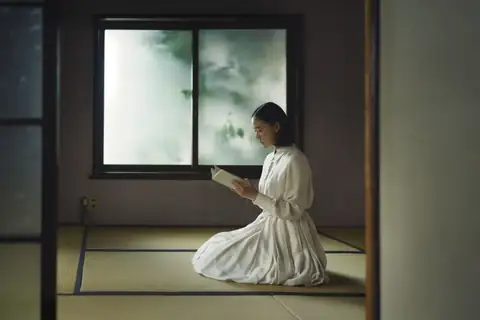
Maha Harada rightly saves the mysterious key reveal for the end, but it is already apparent that Satomi has emerged from her cocoon as a mousy wallflower when she appears for the first time in a white dress that is the height of femininity (the film’s costumes, which play such a central role, were designed by the director’s own company École de Curiosités cofounded by Hans Ito.)
As befits the subject, the stunning visual images are painstakingly composed by D.P. Yoshio Kitagawa, who worked with Ryusuke Hamaguchi on Evil Does Not Exist, as did editor Azusa Yamazaki. Mamiko Hirai’s music contribution includes many of his delicate piano solos, reinforcing the mood.
Shown for this design preview. Read it on thefilmverdict.com.